
Understanding your ecommerce fulfillment cost starts with a simple question: what does it really cost to get an order to your customer?
You found a product you can sell for $45.
It costs you $15.
That leaves $30.
Pretty good business, right?
Potentially, yes.
But one of the most important things a new ecommerce brand can learn is that the difference between your selling price and your product cost isn’t quite your actual margin.
Understanding your true ecommerce fulfillment cost means looking at much more than simply picking and packing an order. There are costs involved in getting that product from the factory all the way to your customer’s front door. Once you understand those costs, you can price intelligently, set better shipping policies, create smarter promotions, and find opportunities to make each order significantly more profitable.
The good news is that the math doesn’t have to be complicated.
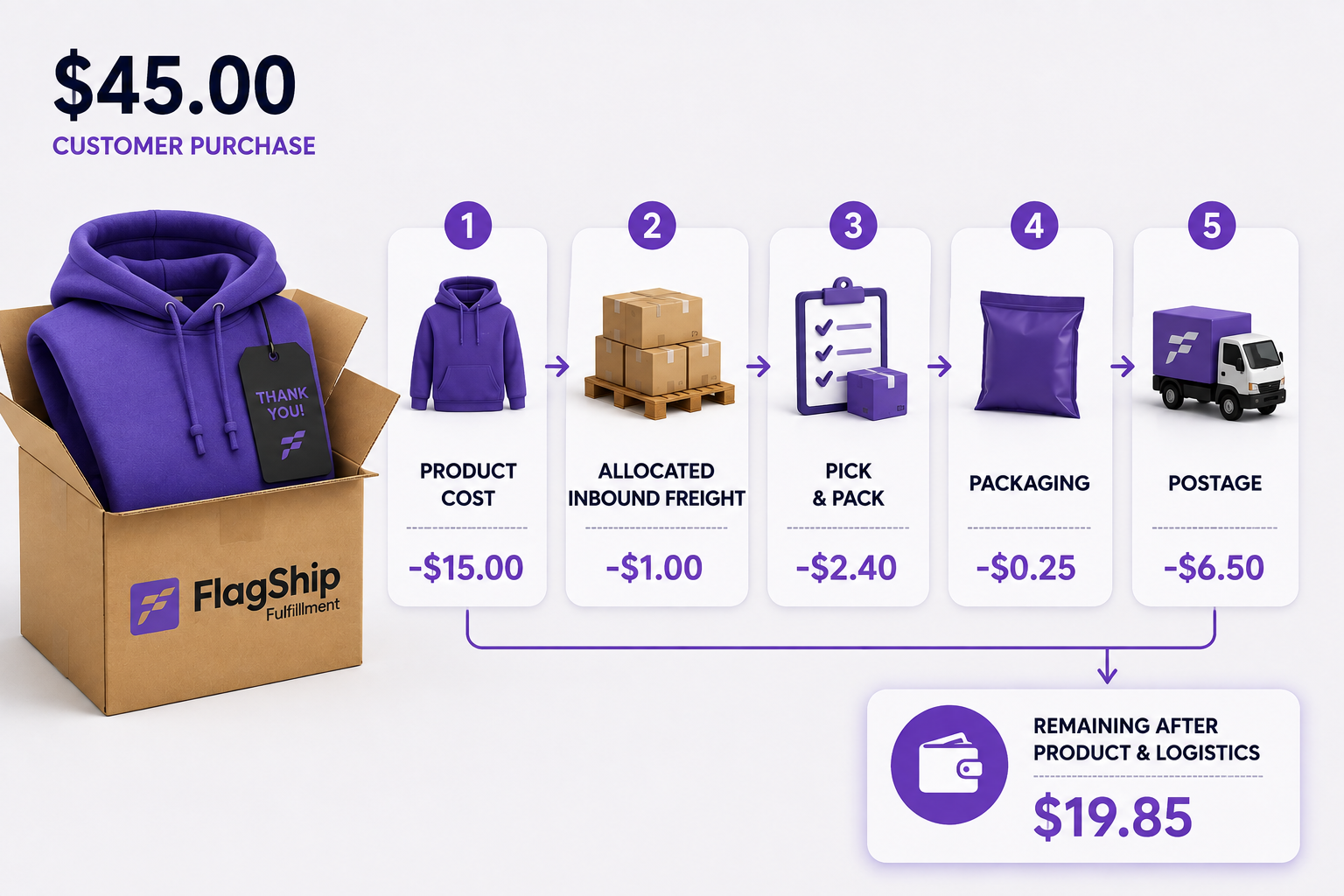
Let’s follow a $45 hoodie from your supplier to your customer’s door.
Start With Your Product Cost
Let’s imagine a startup apparel brand selling a hoodie online.
Selling price: $45
Product cost: $15
That gives us $30 between the product cost and selling price.
That’s a great starting point.
Now let’s figure out what it actually costs to deliver the order.
Step 1: Account for Getting Your Inventory to the Warehouse
Your inventory needs to get from your manufacturer to wherever you’re fulfilling orders.
Depending on where your products are manufactured, this could include international freight, customs and brokerage, domestic freight, or simply the cost your supplier charges to ship the inventory to your warehouse.
The easiest way to account for this is often to spread the total inbound transportation cost across the units received.
For example, if getting 2,000 hoodies from your supplier to the warehouse costs $2,000:
$2,000 ÷ 2,000 units = $1.00 per hoodie
That means our $15 hoodie really costs us approximately $16 landed at the warehouse.
This is an important number to know because it gives you a much more accurate picture of your true product cost.
Step 2: Calculate Your Ecommerce Fulfillment Cost
Once a customer places an order, someone has to pick the product, pack it and prepare it for shipment.
If you’re doing this yourself, there’s still a cost—your time, employees, space, software and equipment.
Once you outsource fulfillment to a 3PL, that cost becomes much easier to measure.
For example, at FlagShip Fulfillment, a typical pick-and-pack structure might look like:
First item in the order: $2.40
Each additional item: $0.80
For our one-hoodie order, we’ll use:
Fulfillment: $2.40
We’ll come back to that additional-item price shortly, because it’s actually one of the most interesting opportunities in ecommerce economics.
Step 3: Don’t Forget the Packaging
The hoodie needs something to travel in.
For apparel, that may be a simple poly mailer. Other products may require a carton, protective material or more specialized packaging.
Let’s assume:
Poly mailer: $0.25
It’s a small number, but it belongs in the calculation.
Your packaging strategy can also become more sophisticated as your brand grows. Custom packaging, inserts and other touches may improve the customer experience, but you should know what each one adds to the cost of an order.
Step 4: Understand Your Actual Postage Cost
Now we need to get the package to the customer.
For many ecommerce brands, postage is the largest logistics expense associated with an individual order.
However, postage isn’t one fixed number. Factors such as the following can affect what you pay, and USPS, for example, explains how weight, dimensions and shipping zones can affect postage pricing.
- Package weight
- Package dimensions
- Destination
- Carrier
- Service level
- Shipping zone
- Available carrier discounts
- Applicable surcharges
For our example, let’s assume the packaged hoodie costs:
$6.50 to ship
Now we have a much better picture of the order:
| Item | Amount |
|---|---|
| Customer purchase | $45.00 |
| Product cost | -$15.00 |
| Allocated inbound freight | -$1.00 |
| Pick & pack | -$2.40 |
| Packaging | -$0.25 |
| Postage | -$6.50 |
| Remaining after product & logistics | $19.85 |
That’s the number we really wanted to understand.
Our $45 order has approximately $19.85 remaining after product and logistics costs.
That doesn’t mean $19.85 is your final net profit. There are other aspects of running a business, of course.
But for understanding the economics of fulfilling this particular order, we now have a much more useful number than simply “$45 minus $15.”
And once you know that number, you can start improving it.
This Is Where the Math Gets Interesting
Understanding your logistics costs shouldn’t discourage you from ecommerce.
It should do exactly the opposite: give you the information you need to make better decisions.
There are several levers you can pull to improve the economics of an order.
And one of the most powerful is surprisingly simple:
Get Your Customer to Buy More Than One Item
Let’s say our customer buys two $45 hoodies instead of one.
Revenue just increased from:
$45 → $90
Product cost obviously doubles:
$15 → $30
But look at what happens to many of the logistics costs.
We don’t need two separate shipments.
We don’t need to pay the first-item fulfillment charge twice.
We’re still shipping to one customer at one address.
At FlagShip, using our example pricing, the fulfillment cost goes from:
One item: $2.40
to:
Two items: $3.20
That’s only $0.80 more in fulfillment to process another $45 product.
Postage will probably increase because the package is heavier, but it usually doesn’t double.
Packaging may increase slightly—or may not increase at all if both items fit comfortably in the same mailer or carton.
That creates very different economics.
One Hoodie vs. Two
Let’s use simplified illustrative shipping numbers.
| 1 Hoodie | 2 Hoodies | |
| Revenue | $45.00 | $90.00 |
| Product cost | $15.00 | $30.00 |
| Inbound freight | $1.00 | $2.00 |
| Fulfillment | $2.40 | $3.20 |
| Packaging | $0.25 | $0.35 |
| Postage | $6.50 | $8.00 |
| Remaining | $19.85 | $46.45 |
Look at what happened.
The customer spent another $45, but the outbound logistics cost increased by only about $2.40 in this example.
Our dollars remaining after product and logistics went from:
$19.85 → $46.45
That’s a major difference.
This is why average order value (AOV) matters so much in ecommerce.
Getting an existing customer to put another item into an order can be dramatically more profitable than generating an entirely separate one-item order.
A Real Example: Turning Fulfillment Data Into a Better Sales Strategy
This kind of analysis is part of how we work with our clients at FlagShip.
One example was Lynn, the owner of a European sports apparel brand that was expanding into the U.S. market.
Lynn’s products averaged around $45 per item, and much of the company’s marketing was done through social media influencers. Several times a year, the brand would release new product “drops,” generating bursts of attention and orders around each new collection.
When Lynn began selling in the U.S., she initially approached shipping in a way that seems perfectly logical: charge the customer approximately what it costs to ship that particular order.
But postage isn’t identical on every order.
The cost depends on where the customer lives, what they order, the weight of the package and other factors. That meant the shipping charge could vary from customer to customer—and customers didn’t necessarily know what shipping would cost until they reached checkout.
So we went through Lynn’s actual fulfillment data with her.
Rather than focusing on individual shipments, we provided her with a complete data set showing what she was actually spending on postage and fulfillment across her orders. From there, we calculated her average fulfillment and postage cost per order.
That gave her a much more useful number.
Instead of asking:
“Exactly what will this particular package cost me to ship?”
she could ask:
“On average, what does it cost me to fulfill and ship an order?”
Once Lynn knew that number, she could confidently move to a flat shipping fee based on her real average costs.
Some orders would inevitably cost a little more than the flat fee to fulfill and ship. Others would cost a little less. But across her orders, she now had a shipping charge designed around what fulfillment and postage were actually costing her.
And it gave her customers something valuable too:
Predictability.
Customers could know what shipping would cost instead of discovering a variable charge at the end of checkout. For Lynn, that had the added benefit of reducing shipping-related cart abandonment in her Shopify store. Customers were more comfortable completing their purchases when the shipping charge was clear and predictable.
But the fulfillment data revealed another opportunity.
What If Customers Bought the Whole Set?
Because Lynn sold sports apparel in coordinated collections, customers didn’t necessarily have to buy just one $45 piece. They could buy multiple pieces—or an entire set.
From a logistics standpoint, that was much more efficient.
If a customer bought a second piece, Lynn gained another item’s worth of revenue, but she didn’t incur another complete order’s worth of logistics costs.
There was no second shipment to the same customer.
There was no second shipping label.
The fulfillment cost increased only by the additional-item charge.
Postage increased somewhat because the package was heavier, but it didn’t double.
So we worked with Lynn to create incentives that encouraged customers to purchase a complete set rather than a single piece.
This was especially useful for the way she marketed her business. When an influencer promoted a new drop, the opportunity wasn’t necessarily limited to generating as many individual transactions as possible. We could also make each of those transactions more valuable by encouraging customers who were already excited about the collection to purchase more of it at once.
The customer could receive a more attractive offer for buying the set, while Lynn benefited from much better economics on a multi-item order.
The Data Changed the Conversation
What’s important about this example isn’t simply that we helped a client choose a flat shipping fee.
It’s how we got there.
We weren’t guessing at what consumers might tolerate for shipping.
Lynn wasn’t guessing at what her logistics costs might be.
We took her actual order data and showed her:
Here’s what you’re really spending on fulfillment.
Here’s what you’re really spending on postage.
Here’s your average cost per order.
Here’s what happens to those costs when a customer adds another item.
Once she understood those numbers, she could make informed decisions about what to charge for shipping and what kinds of offers she could afford to make.
That’s the kind of relationship we try to have with our clients at FlagShip Fulfillment.
Sometimes the opportunity is packaging. Sometimes it’s the shipping service being used. Sometimes it’s the structure of a shipping charge. Sometimes it’s encouraging customers to purchase more items in a single order.
But it starts with transparency.
Your fulfillment company has access to valuable information about how your business actually operates. You should have access to it too.
And when you understand that information, fulfillment stops being just an expense to manage.
It becomes data you can use to make better business decisions.
Think About Shipping Charges Strategically
Another important question is:
How much should you charge your customer for shipping?
There isn’t one universal answer.
Charging the exact postage cost isn’t necessarily the best strategy.
Neither is automatically offering free shipping.
And charging a high shipping fee that only appears at checkout can sometimes make an attractive product suddenly feel expensive.
The better question is:
What shipping offer gives the customer a compelling reason to complete the purchase while still making economic sense for the business?
That might mean:
- A flat shipping rate
- Free shipping above a certain order value
- Partially subsidized shipping
- Free shipping on multiple-item orders
- Different shipping options at checkout
We’ll cover this separately in our guide to how ecommerce brands should set shipping charges to increase conversion and average order value.
But your fulfillment partner can help here too.
Before deciding what customers should pay, you need good data on what your orders actually cost to ship.
Free Shipping Thresholds Can Encourage Bigger Orders
Here’s where our two-hoodie example becomes especially useful.
Suppose instead of simply advertising:
Free Shipping
you offer:
Free Shipping on Orders Over $75
Our $45 hoodie customer now has a reason to look around.
Maybe they add a second hoodie.
Maybe they add a T-shirt.
Maybe they buy an accessory.
You haven’t merely given away shipping.
You’ve used shipping as a tool to potentially increase your average order value.
And as we saw earlier, the logistics cost of that additional item may increase far more slowly than the revenue from it.
The exact threshold should depend on your products, margins, average shipping costs and customer behavior.
But that’s the larger lesson:
Shipping shouldn’t only be viewed as an expense. It can also be part of your sales strategy.
Don’t Forget That Carrier Pricing Changes
One other factor deserves to be built into your planning.
Carrier pricing doesn’t stay perfectly constant.
Carriers adjust rates periodically, and certain surcharges or peak/demand charges can change throughout the year.
That doesn’t need to be scary.
It simply means you shouldn’t build a business model that only works if your shipping expense stays frozen forever.
If your average postage cost moves from $6.50 to $6.90, understand what that does to your margins.
Then decide whether you need to adjust your product pricing, shipping charges, free-shipping thresholds, packaging, or carrier/service selection.
The key is simply to know your numbers.
The Number Every Ecommerce Brand Should Know
If you’re starting or growing an ecommerce brand, there’s one question worth being able to answer:
What does it actually cost to get my average order into my customer’s hands?
At a basic level:
Product cost + inbound transportation + fulfillment + packaging + postage = your basic delivered order cost
You can make your model more sophisticated as your business grows.
But start there.
Then calculate it for different types of orders.
What does a one-item order cost?
What does a two-item order cost?
What does your typical order cost?
What happens at your free-shipping threshold?
Those numbers can help you make smarter decisions about pricing, promotions, bundles, shipping offers and advertising.
Know Your Numbers—Then Use Them
The point of calculating your true logistics costs isn’t to discover reasons not to sell online.
It’s to discover how to sell online more intelligently.
If our hypothetical apparel brand had simply assumed:
$45 sale – $15 product = $30
it wouldn’t have had enough information to make good decisions.
Now it does.
It knows approximately what a one-item order costs. It can see how much more attractive the economics become when a customer purchases two products. It can experiment intelligently with a free-shipping threshold. It can decide how much shipping to charge instead of guessing.
And it can work with its fulfillment company to identify opportunities to improve those economics as volume grows.
That’s a much stronger position for a startup brand to be in.
At FlagShip Fulfillment, that’s how we want our clients to think about fulfillment.
Your 3PL sees something incredibly valuable: how your orders actually move.
What do they weigh? Where are they going? What packaging are they using? What happens to shipping costs when another item is added? Where might money be saved? And how can those answers influence what you’re offering your customers?
The goal isn’t simply to spend less on fulfillment.
It’s to understand your fulfillment economics well enough to build a more profitable ecommerce business.
Want to Know What Your Orders Really Cost?
Every ecommerce business has different products, order patterns and shipping costs. At FlagShip Fulfillment, we help clients understand what they’re actually spending on fulfillment and shipping—and look for opportunities to make those numbers work better for their business.
If you’d like us to take a look at your fulfillment needs and talk through the numbers with you, we’d be happy to have a conversation.